

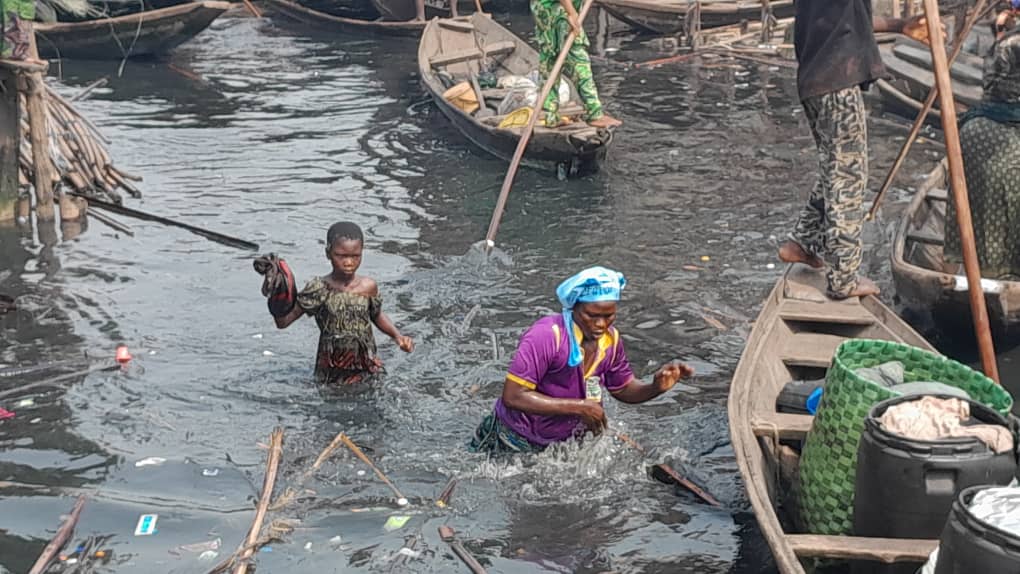
Thousands of residents of Makoko, Lagos’ historic waterside community, were left standing in the lagoon beside the splintered remains of their homes this January as state demolition crews carved yet another hole in the city’s shoreline. What the government describes as urban renewal and safety enforcement looks, from the water, like a familiar story of erasure, forced displacement and a future being planned without the people who already live there.
A message from the lagoon
One evening in early January, a message lit up the phone in London with grainy photos from an old friend in Makoko. Women and children were waistdeep in the lagoon clutching basins, mattresses and cooking pots, while an excavator’s steel arm punched through timber walls behind them. It was impossible to tell where the water ended and the wreckage began; only the sound of machinery and the silhouettes of familiar houses on stilts gave away that this was the community that had welcomed a stranger more than a decade ago.
For days the images kept coming. Bulldozers edging closer to clusters of homes, smoke after tear gas, boats piled high with belongings and elders trying to negotiate with officials on floating planks that used to be verandas.
Friends sent voice notes describing nights spent in canoes because dry platforms were gone, and rumours that the demolition line might advance further down the lagoon at any moment.
First encounters with Makoko
Makoko entered this story long before the latest demolitions. The first journey to Lagos was in 2014, to work on a green school in Ikeja, a project that would lead to many returns to Africa’s largest city. That trip also brought an introduction to the Social and Economic Rights Action Centre (SERAC), a small office of determined human rights lawyers who had been defending residents of Lagos’ informal settlements since the 1990s, often in courtrooms where the poor were expected to remain invisible. SERAC’s cases have challenged forced evictions across Lagos and even reached the African Commission on Human and Peoples’ Rights, arguing that demolitions without consultation, notice or resettlement violate basic rights to housing and dignity.
In their cramped meeting room, maps of communities like Makoko were pinned beside legal briefs, each map a reminder that the city’s celebrated skyline rests on the threatened ground—and water—of its poorest citizens. A community on water Makoko itself sits across from Lagos’ Third Mainland Bridge, a dense patchwork of timber houses on stilts and narrow walkways stitched together by dugout canoes. Often called the “Venice of Africa”, it began life in the 18th century as a small fishing village. Today tens of thousands of people, many from the Egun ethnic group who migrated from Badagry and Benin, depend on the lagoon for their livelihoods.
Unlike the artificial islands now marketed as Lagos’ future, Makoko’s architecture is an incremental response to tides, storms and scarcity: homes elevated above rising waters, canoes that double as school buses, and informal wasteclearing initiatives that mobilise young people to dredge clogged canals.
The community’s problems are real—overstretched schools, precarious sanitation, patchy electricity and limited health care—but they are managed largely without state support, in a selforganised landscape that has long mastered the art of living at the water’s edge.
Demolitions by the metre
Officially, the latest demolitions are framed as a safety operation: buildings, the Lagos State government says, have crept too close to highvoltage power lines and must be cleared to prevent disaster. Residents and rights groups, however, point out that such justifications have surfaced whenever waterfront land grows valuable, and that enforcement is selective in a city where luxury estates routinely ignore planning regulations.
This is not Makoko’s first experience of the bulldozer. In 2012 and 2013 parts of the settlement were razed with little warning, leaving thousands homeless and prompting domestic and international condemnation. The pattern mirrors other notorious Lagos clearances, including the eviction of Maroko in 1990, when more than 300,000 people were displaced to make way for highend developments along the same coastline that now hosts gated estates and private beaches.

Visions from architects and activists
Makoko has also attracted a procession of architects, planners and international experts, drawn by its precarious beauty and the challenge of designing “the Venice of Lagos”. Workshops have been run with students from universities as far apart as Zurich and New York, often in partnership with SERAC, to imagine schools, clinics and housing that could upgrade conditions without uprooting residents. The most famous of these interventions was the Makoko Floating School, designed by Nigerian architect Kunlé Adeyemi as a prototype for floodresilient classrooms. The triangular timber structure, resting on a buoyant base, attracted global acclaim and won the Silver Lion at the 2016 Venice Architecture Biennale, becoming a symbol of African ingenuity in the face of climate risk.
From prototype to policy vacuum
Yet the floating school’s international success did not translate into a systematic upgrading of Makoko. The prototype itself partially collapsed after a storm in 2016, and while a refined iteration, MFS II, sailed to Venice, no fleet of floating classrooms appeared on the lagoon. For residents, the awards raised an uncomfortable question: if Makoko can inspire juries in Venice, why can it not persuade authorities in Lagos to invest in water-sensitive infrastructure instead of more demolitions.
After an earlier wave of evictions, SERAC and a coalition of architects, urbanists and community organisers drew up an alternative redevelopment plan for Makoko and neighbouring settlements, emphasising insitu upgrading, community participation and the preservation of livelihoods. The plan proposed modest but practical interventions—sanitation hubs, safer walkways, resilient housing—that could be phased in without wholesale clearance, but it struggled to gain political traction in a development culture fixated on blankslate megaprojects.
The mirage of new islands
Just along the coast, glossy billboards advertise Eco Atlantic and other landreclamation schemes as Africa’s answer to Dubai. These projects promise climateproof living in highrise towers on artificial islands dredged from the Atlantic, yet critics warn that they worsen flooding in adjacent lowincome districts by displacing water and destroying natural buffers. During heavy rains, sections of Lagos’ formal city—its highways, gated estates and shopping malls—reliably go under water, while Makoko’s stilt houses remain above the tide.
The irony is hard to miss: the community most often branded “illegal” has developed some of the city’s most adaptive architecture, while statebacked “ecocities” built on sand struggle against the very sea they claim to tame.

Whose future for African cities?
At the World Design Congress last year, one of the star speakers, British architect Norman Foster, praised a project in India that upgraded an informal settlement through close engagement with residents, arguing that the future of urbanism lies not in tabula rasa schemes but in patient, ethnographic understanding of people’s cultures and needs. In the same breath, he warned that bulldozing ancestral neighbourhoods to replace them with anonymous glass towers produces cities that are neither socially resilient nor environmentally sustainable.
Lagos, like many African metropolises, already embodies a different possibility: a city where hypermodern highrises on Victoria Island coexist with neighbourhoods governed by traditional chiefs, where burial rites, market days and water rituals still shape how space is used. Urban theorists from Rem Koolhaas onwards have argued that such places, messy and improvised, are laboratories of innovation, precisely because they refuse the clean lines of Western planning orthodoxy.
Holding on in the lagoon
As this January’s demolitions push deeper into Makoko, the people clinging to their timber platforms are not simply resisting eviction; they are defending a fragile but sophisticated way of inhabiting a threatened coastline. Each flattened house erases not just a shelter but a microeconomy of fish smoking, boat building, childcare and informal education that cannot easily be transplanted to a distant relocation camp on dry land.
From the vantage point of a phone screen thousands of kilometres away, the scene looks both familiar and newly unbearable: bulldozers, soldiers, women wading in water, children watching a home become debris. The real question for Lagos—and for all cities racing to become “global” by copying the same waterfront skylines—is whether their future will be built on the ruins of communities like Makoko, or with them, on foundations that are participatory, sustainable and rooted in the cultures that made the city possible in the first place.